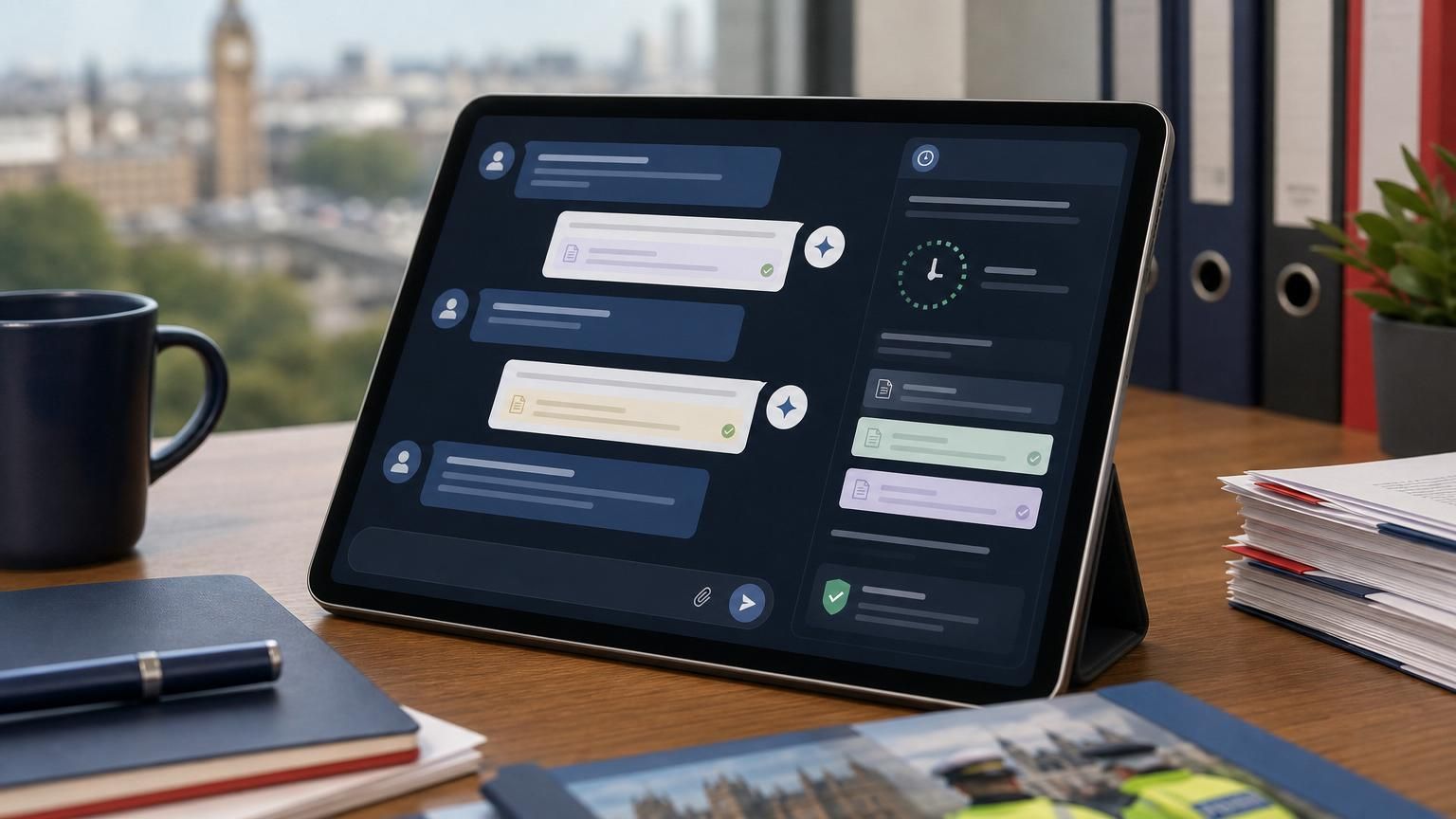
Why 'one-touch, verifiable' support is now table stakes
Organisations that care about trust — councils, police non-emergency teams, housing associations and regulated services — need more than quick replies. They need a single interaction that: captures the right facts, delivers an authoritative answer, records the evidence, and triggers an SLA-backed outcome or escalation when required.

Live chat already moves the needle commercially: companies report up to a 20% uplift in conversion after introducing chat on high-intent pages, and about 40% of customers who engage with live chat are more likely to complete a purchase. These same mechanics—speed, context and conversion—translate directly into public sector value when the objective is faster service resolution and fewer repeat contacts. ()
The practical problem: fast answers vs. accountable answers
Speed alone creates risk for regulated teams. A rapid, confident AI reply that cannot be verified becomes a liability under FOI, subject access requests or internal audit. Conversely, rigid rule-based flows are safe but brittle: they push users into forms and cause drop-off.
The operational sweet spot is a system that delivers a fast, evidence-linked answer and a clear human escalation path — all hosted in the UK to meet data-sovereignty and procurement expectations.
Three architectures explained — and why hybrid wins for regulated services
Rule-based chatbots
- Drive predictable scripted journeys (pre-chat forms, decision trees).
- Strengths: deterministic, easy to audit, low hallucination risk.
- Weaknesses: poor handling of novel queries, poor conversion on complex intents.
Pure LLM bots
- Generate fluent, context-aware replies from the model's training data.
- Strengths: natural language, flexible responses.
- Weaknesses: hallucinations, limited provenance, harder to certify for regulated decisions.
Hybrid AI live chat (recommended for UK public & regulated teams)
- Combines RAG (retrieval-augmented generation) to ground answers in your documents with conditional workflows that hand off to humans when a decision needs authority.
- Strengths: fast, source-attributed answers, measurable handoff metrics, can be UK-hosted to keep data sovereign and audit-ready. (imsupporting.com)
Hybrid setups let AI triage and resolve routine queries while routing complex or high-risk interactions to trained staff — preserving both speed and accountability.
How to design SLA-backed, verifiable one-touch workflows (practical blueprint)
- Define decision tiers
- Triage (AI-resolvable): FAQs, status checks, simple guidance.
- Authority (human sign-off): case changes, policy interpretations, special-category data handling.
- Ground every AI reply in sources
- Use RAG to return the passages, paragraph IDs or document references used to form the answer.
- Display a short source summary to the agent and store full provenance in the transcript. This preserves auditability and reduces FOI friction. (imsupporting.com)
- Automate SLA triggers
- If AI resolves within defined parameters, record resolution and close with an SLA timestamp.
- If escalation occurs, create a ticket with the AI transcript, RAG excerpts and a required response SLA for human agents.
- Make the handoff seamless and measurable
- Use a visual workflow engine to set conditions (office hours, risk flags, user verification) and measure drop-off, escalation time, and one-touch rate. These KPIs let you make the case for reinvesting savings. (imsupporting.com)
- Keep hosting and logs in the UK
- For councils, police and regulated organisations, UK-hosting avoids cross-border ambiguity and supports procurement and DPIA processes. Tie retention policies to local requirements so transcripts are FOI-ready and secure.
KPI playbook — what to measure first
- One-touch resolution rate (target: increase by 15–30% in first 6–12 months).
- Time-to-first-resolution (measure before and after AI triage).
- Escalation accuracy (percentage of escalations that required human intervention).
- Source-linked resolution ratio (share of AI answers with verifiable RAG citations).
A lightweight dashboard that surfaces these metrics will be the single most persuasive asset for finance and procurement teams.
Security, compliance and the regulator view
Grounding AI answers with RAG and keeping processing within UK infrastructure are straightforward mitigations against hallucination and unlawful data transfers. The ICO has set expectations around transparency, lawful bases and auditability for AI systems used with personal data — so make DPIAs, retention records and vendor assurances part of every procurement. (cy.ico.org.uk)
Quick operator checklist for a pilot (30–60 days)
- Upload core policy documents, local guides and ticketing APIs into a RAG index.
- Build 3 hybrid workflows: a) general enquiry deflection, b) ticket creation & status lookup, c) high‑risk escalation to a specialist. Use a visual builder to iterate. (imsupporting.com)
- Configure provenance capture: store document IDs, retrieval snippets and confidence scores in the transcript.
- Run a small pilot in one support team, track one-touch rates and SLA compliance for 8 weeks.
Commercial impact — why CIOs and Heads of Service care
- Cost per contact falls as routine queries are handled instantly; agents focus on complex tasks.
- Faster first-time resolutions reduce downstream case handling and follow-up costs.
- Verifiable transcripts reduce FOI effort and legal friction; audit-ready evidence speeds internal reviews.
Use these outcomes to make a procurement case: cost savings + improved citizen experience + reduced regulatory risk = procurement‑friendly ROI.
Where to start: technology and partner criteria
Choose a platform that offers:
- UK-hosted RAG indexing with clear provenance capture. (imsupporting.com)
- A visual hybrid workflow builder to model routing, handoffs and SLA triggers. (imsupporting.com)
- Configurable retention and export for FOI or audit needs.
- Transparent data-processing terms and an up-to-date DPIA template.
If you already run a ticketing system, ensure the chat can POST/GET ticket data and surface ticket IDs in-chat so users leave the session with a verifiable outcome.
Bottom line and next step (fast CTA)
For UK councils, police non-emergency teams, housing associations and regulated organisations, the future of support is not “AI instead of people” — it’s AI that reliably produces verifiable, SLA-backed outcomes and escalates decisively when authority is needed. That design reduces risk, improves one-touch resolution rates, and preserves procurement integrity.
Explore UK-hosted hybrid AI chat workflows and RAG-powered agent knowledge to pilot an SLA-backed one-touch programme today: https://imsupporting.com/ and see specific feature guides on RAG AI knowledge and hybrid chat workflows for operational teams. (imsupporting.com)
Start a 30-day pilot with UK hosting and audit-ready transcripts — get in front of your service KPIs and prove one-touch value fast. Visit https://imsupporting.com/ to book a demo and download workflow examples.