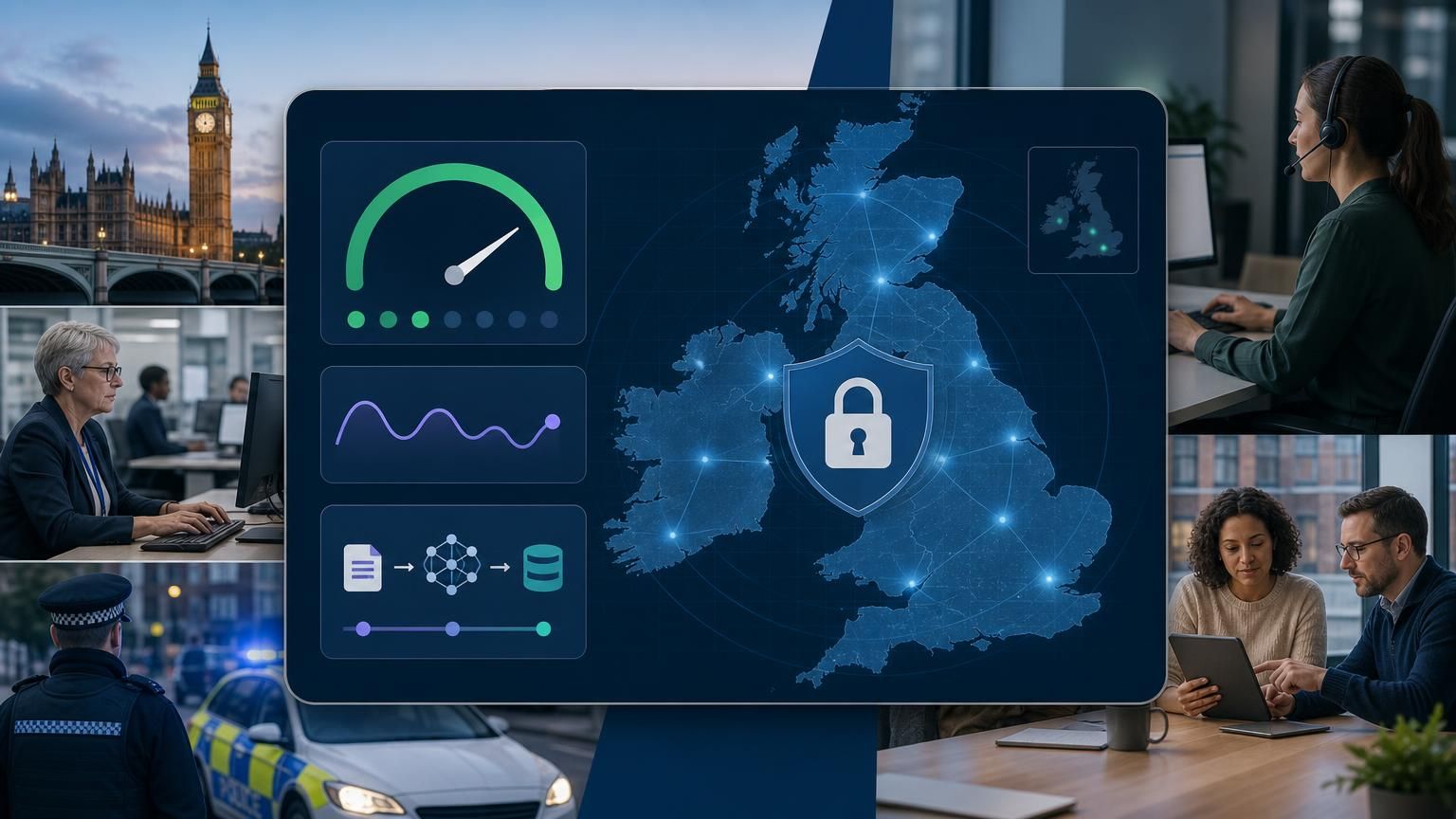
Why public sector teams must treat live chat like a contract
Live chat is no longer an experimental channel for FAQs. For councils, police, housing associations and regulated teams, live chat must deliver predictable performance, auditable decisions and data-residency guarantees — the same assurances you expect from any supplier in a formal procurement. Gartner and industry analysis show rapid GenAI adoption across customer service functions, increasing pressure on leaders to move beyond pilots and embed measurable outcomes. ()

The practical consequence: if live chat is used for case intake, sensitive advice, or regulated decisions, you need SLA‑grade commitments for availability, triage accuracy, handover times and data handling. This post explains how to design those SLAs for UK-hosted hybrid AI live chat and which metrics and controls procurement, security and support teams should insist on.
Rule-based bots, pure LLM bots and hybrid AI — what to contract for
- Rule-based chatbots: deterministic scripts, known limits, easy to audit but brittle on unexpected queries. Good for fixed forms and clear procedural flows.
- Pure LLM bots: flexible and conversational but probabilistic — they can hallucinate, leak training data, or behave unpredictably without governance.
- Hybrid AI live chat: AI handles triage, short answers and context enrichment but hands off to a human when the conversation is high‑risk or ambiguous. Hybrid is the only pragmatic path for SLA-driven public sector use because it combines speed with human judgement and audit trails.
Design SLAs with different expectations per channel component — don’t treat them as one monolith.
Core SLA metrics you should specify (and why they matter)
- Availability (Uptime): % uptime for the whole service and for UK-hosted inference or data storage. Public sector contracts typically require clear statements about geographic hosting and resilience. (gov.uk)
- AI triage accuracy: measured against labelled test sets; SLA could specify >85% intent classification on critical routes and a maximum false-negative rate for high-risk intents.
- Handover latency: time from AI flagging a human escalation to the human agent accepting the thread — target 15–60 seconds depending on criticality.
- Human response SLA: time-to-first-human-reply for escalations (for urgent channels, 2–10 minutes is realistic; for routine channels, 1 business hour may be acceptable).
- Provenance logging and explainability: every AI answer must include provenance metadata (knowledge source, RAG confidence, timestamp) as part of the audit trail.
- Data residency and export controls: clear proofs that personal data and model inference logs remain in UK jurisdictions unless explicit consents and lawful transfers are documented. (ncsc.gov.uk)
These SLAs should map to penalties, remediation plans and defined runbooks in supplier contracts.
Practical controls: how to make SLAs enforceable
Operational telemetry and test harnesses
Require continuous synthetic testing and monthly accuracy reports. Supplier must expose read-only dashboards and exportable logs for independent verification.
RAG-backed knowledge with governance gates
Use RAG (retrieval-augmented generation) so every answer cites a verifiable document. That makes it possible to measure the source coverage and remove outdated or sensitive passages quickly. Demand a documented RAG-refresh cadence and a manual sign-off process for high-risk collections. See an example RAG feature that supports audit trails and selective redaction. https://imsupporting.com/feature-rag-based-ai-agent-knowledge.php
Risk-based escalation policies
Define rules that force handovers when certain signals appear: PII, safeguarding keywords, legal/benefit decisions, or user-declared vulnerability. The hybrid model must be able to switch autonomy levels dynamically and log the trigger and decision path.
Procurement language to include in tenders and statements of work
- Data residency clause: “All personal data, model inputs and inference logs shall be processed and stored on infrastructure physically located within the UK.” (gov.uk)
- Evidence and audit rights: “Customer may request quarterly exports of anonymised inference logs and provenance metadata for audit.”
- DPIA and ADM requirements: supplier to deliver DPIA outputs and compliance notes aligned to ICO AI guidance for processing decisions and transparency. (ico.org.uk)
- Remediation SLAs: clear RTO/RPO for knowledge updates and emergency remove/overwrite capability for problematic documents.
These clauses keep you out of reactive governance and simplify ICO engagement when needed.
The risk landscape: why governance beats novelty
Organisations are scaling GenAI fast, but examples of rollbacks and governance failures are increasing — showing that speed without control is risky. Recent industry reporting documents deployments being rolled back where governance wasn't strong. ()
At the same time, public sector cloud and security guidance stresses asset protection, resilience and the legal risks of offshoring processing. That matters when you promise citizens a secure, auditable service. (ncsc.gov.uk)
What good looks like in UK practice: an example SLA bundle
- 99.9% service availability (with UK-hosted data centres and resilience zones).
- AI triage precision ≥ 85% on priority intents (monthly verification).
- Handover latency: median ≤ 30 seconds on flagged cases; 95th percentile ≤ 2 minutes.
- Provenance attached to 100% of AI-originated answers; exportable JSON for all conversations.
- Monthly DPIA updates and quarterly independent audit reports.
These targets are intentionally prescriptive — they make procurement simple and measurable.
Implementing with hybrid AI workflows (operational checklist)
- Start small: run hybrid AI on a single regulated process (e.g., housing benefit triage) for 6–12 weeks.
- Build a living test suite that reflects edge-case queries and vulnerability scenarios.
- Require RAG sources to be whitelisted and time-limited; record every source used in an answer.
- Define human-in-loop acceptance criteria and a fast rollback path for knowledge items.
If you want a practical example of hybrid AI workflow patterns that embed handover rules and auditable trails, see this feature overview. https://imsupporting.com/feature-hybrid-ai-chat-workflows.php
The commercial case: why SLAs win procurement and trust
A well-specified SLA removes procurement blockers and reduces the need for bespoke legal exceptions. It also protects citizens and staff by ensuring repeatable behaviour — and it turns chat from an experimental channel into a contract-backed service line.
Gartner forecasts rapid growth in AI-mediated customer interactions, underscoring why public sector buyers should act now to lock in safe, auditable services rather than retrofitting governance later. ()
Next steps — checklist for decision-makers
- Draft an SLA appendix with uptime, triage accuracy, handover latency and provenance requirements.
- Ask suppliers for monthly exports and an externally verifiable test harness.
- Require UK-hosted processing and a documented DPIA aligned to ICO guidance. (ico.org.uk)
If you want to see these ideas in a UK-hosted platform built for auditable hybrid AI live chat, review IMSupporting’s hybrid AI and RAG features and request a technical walkthrough. https://imsupporting.com/
Final verdict
Treat hybrid AI live chat as a service you must be able to audit, measure and contract against. With the right SLAs, UK-hosted RAG, and enforced handover policies, councils, police and regulated teams can gain the responsiveness of AI while preserving legal certainty and citizen trust.
Ready to convert your live chat into an SLA-backed public service channel? Book a demo and view feature details at IMSupporting: https://imsupporting.com/