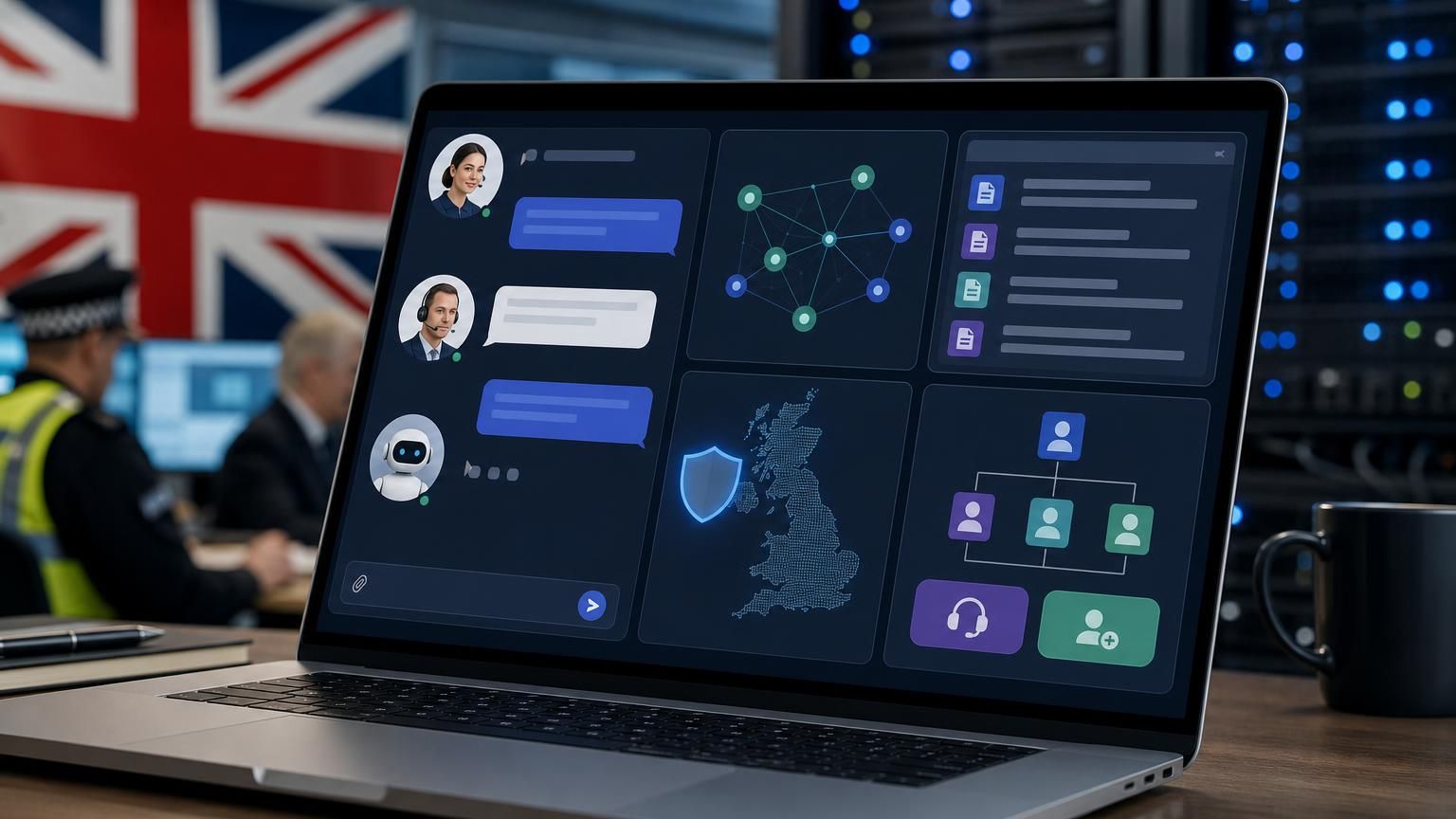
Why lead with orchestration, not another chat widget
Most organisations treat live chat as a channel — a widget tacked onto the website. The next wave will treat live chat as the orchestration layer that connects people, systems and policy around a single interaction. That shift matters for UK businesses, councils, police and regulated teams because it reduces handoffs, enforces processing location, and automates repeatable workflow steps under audit-ready controls.

Live chat used this way becomes the engine that runs: triage → evidence capture → CRM case creation → specialist handoff → automated follow-up. The benefits are measurable: field studies of GenAI applied to retail workflows report conversion uplifts ranging from 1% to 22% in experimental settings, showing the technology can materially change outcomes when applied to transaction‑heavy journeys. ()
The three tech flavours you need to design around
Rule‑based chatbots
- Deterministic scripts and decision trees. Good for static FAQs, form filling and navigation prompts.
- Low risk, easy to audit, but brittle when the requirement changes.
Pure LLM bots
- Large language models produce natural answers and open text understanding. Great for broad coverage and intent detection but can hallucinate, and models often process data outside your chosen jurisdiction unless architected otherwise.
Hybrid AI live chat (the orchestration sweet spot)
- Hybrid systems combine LLM intent‑detection + retrieval (RAG) + explicit business rules + seamless human handoff. That combination delivers: fast, confident answers for routine queries; automated workflow kicks for repeatable cases; and guaranteed human control for exceptions.
- For UK public sector and regulated teams, hybrid setups allow you to keep sensitive data and derived artefacts in‑country while using generative models only on vetted knowledge sources. IMSupporting’s RAG agent knowledge and hybrid workflows are examples of this approach in practice. https://imsupporting.com/feature-rag-based-ai-agent-knowledge.php and https://imsupporting.com/feature-hybrid-ai-chat-workflows.php
Why UK hosting and orchestration are non‑negotiable for many buyers
- Public sector procurement guidance and cloud advice stress a risk‑based approach to cloud adoption: you must know where data is, who can access it, and how it is protected. The GOV.UK public sector cloud guidance makes clear that there are legitimate legal and operational reasons to control data location and access. (gov.uk)
- The NCSC’s cloud security guidance reinforces the need to treat location, jurisdiction and supply‑chain access as part of any cloud design: encrypt, limit exports, and design for separation. An orchestration layer that guarantees UK processing locations and auditable controls maps directly to those recommendations. (ncsc.gov.uk)
- The ICO’s AI and data protection guidance is explicit about governance, DPIAs and embedding data‑protection thinking into AI pipelines — exactly what orchestration enforces by design. (ico.org.uk)
How orchestration reduces risk and cost — practical examples
- Instant triage that captures minimum viable evidence: the hybrid bot collects form fields, verifies identity factors, and creates a time‑stamped case in your CMS. That reduces agent wrap time and preserves an auditable chain.
- Policy‑driven routing: sensitive cases trigger UK‑hosted specialist queues (or human review) automatically, meeting data residency and restricted‑handling rules without manual intervention.
- Automated case enrichment: RAG retrieval pulls the correct policy passages, previous correspondence and case history into the chat transcript for the agent, cutting handling time and rework.
Statistics: B2B adoption of live chat widgets is rising — one industry study found 43.2% of B2B sites now run a chat widget, signalling maturity in the channel and opportunity to move from simple chat to orchestration. ()
Designing the orchestration layer — nine practical controls
- Host primary data and RAG indices in UK data centres.
- Enforce role‑based access and session recording with tamper evidence.
- Apply DPIA and risk scoring to each workflow; automations only run when the risk threshold is met. (ico.org.uk)
- Retain minimal logs for ephemeral stages and full records where audits require them.
- Model governance: freeze provenance of training/support artifacts that feed retrieval indexes.
- Human‑in‑the‑loop gates for decisions that impact rights (benefits, policing actions, regulated outcomes).
- Automated SLA escalation and incident‑aware routing to avoid missed commitments.
- Integration adapters for case management, CRM, payments and identity providers.
- Continuous monitoring and automated red‑team checks for hallucination or data leakage.
A short architecture pattern for UK councils and regulated teams
- Edge listener (UK‑hosted) accepts visitor session and runs lightweight verification.
- Intent detection: a small local model or policy layer classifies query severity.
- RAG retrieval against a UK‑hosted, versioned knowledge index (policy, service pages, internal guidance).
- Hybrid response: auto‑answer for low‑risk; create case + handoff for moderate; immediate human transfer for high‑risk.
- Orchestration engine logs the transcript, builds case metadata, triggers downstream systems and enforces retention rules.
This pattern maps to NCSC guidance on protecting data and defining clear ownership of cloud responsibilities. (ncsc.gov.uk)
Procurement and procurement‑ready artefacts you should demand
- Evidence of UK data residency and where RAG indices live.
- DPIA templates and model cards for any LLM components. See ICO resources for what a DPIA should cover when AI is involved. (ico.org.uk)
- A clear human‑handoff SLA and audit trails that are tamper‑resistant.
- Workflow diagrams showing where automation runs and where human review is mandatory.
Quick win roadmap (90/180/365 days)
- 0–90 days: Map high‑volume support intents, identify regulated touchpoints, and build a UK‑hosted RAG index for those topics.
- 90–180 days: Deploy hybrid triage for top 3 intents, integrate with your case management, and add role‑based routing for sensitive queues.
- 180–365 days: Expand orchestration to low‑risk transactional journeys, tighten provenance controls for training data, and build KPI dashboards for SLA, cost per case and conversion uplift.
Across early GenAI pilots, firms report non-trivial productivity gains when automation is applied to repetitive, well-bounded workflows — the evidence suggests orchestration converts those gains into repeatable operational improvements. ()
How IMSupporting fits this pattern
IMSupporting’s platform is built for hybrid AI orchestration with UK‑hosted knowledge indices and configurable hybrid AI chat workflows — precisely the controls public and regulated organisations need. See their RAG agent knowledge and hybrid chat workflows pages for implementation detail: https://imsupporting.com/feature-rag-based-ai-agent-knowledge.php and https://imsupporting.com/feature-hybrid-ai-chat-workflows.php
If your team needs a procurement‑ready, UK‑hosted orchestration layer that balances generative capability with auditable controls, book a demo and see a live implementation tailored for councils and regulated teams. https://imsupporting.com/
Final checklist before you buy
- Does the vendor host RAG indices and logs in the UK? (required)
- Can the system enforce human gates for regulated decisions? (required)
- Does the vendor publish DPIA and model‑governance artefacts? (required)
- Is the orchestration layer integrable with your case management and identity systems? (highly recommended)
Designing live chat as a support orchestration layer is the next practical step for UK organisations that need speed without sacrificing sovereignty and auditability. Start with a focused pilot on one high‑volume workflow and expand on measurable wins.