Why surge resilience should be a board-level live chat decision
When staff shortages, industrial action or cyber incidents hit, your website and phone lines are where citizens and customers look first. A single overloaded contact channel siloes risk: delayed responses, missed statutory deadlines, frustrated residents, and public complaints. Live chat is no longer just a convenience — it’s a resilience channel that can preserve SLAs and statutory timelines if engineered correctly.

This isn't theoretical. UK public services already use chat as a primary contact channel and guidance for evaluating AI interventions now refers explicitly to digital service replacements such as chatbots and conversational interfaces. (civilservicecommission.independent.gov.uk)
Rule‑based bots, pure LLMs and Hybrid AI — why the difference matters for resilience
Choose the wrong architecture and surge events amplify risk instead of reducing it. Here’s the clean difference:
- Rule‑based chatbots: deterministic scripts and decision trees. Good for form-filling and simple triage but brittle under unexpected queries.
- Pure LLM bots: broad language ability, useful for free-text answers but unpredictable, hard to audit and potentially unsuitable for regulated answers without heavy guardrails.
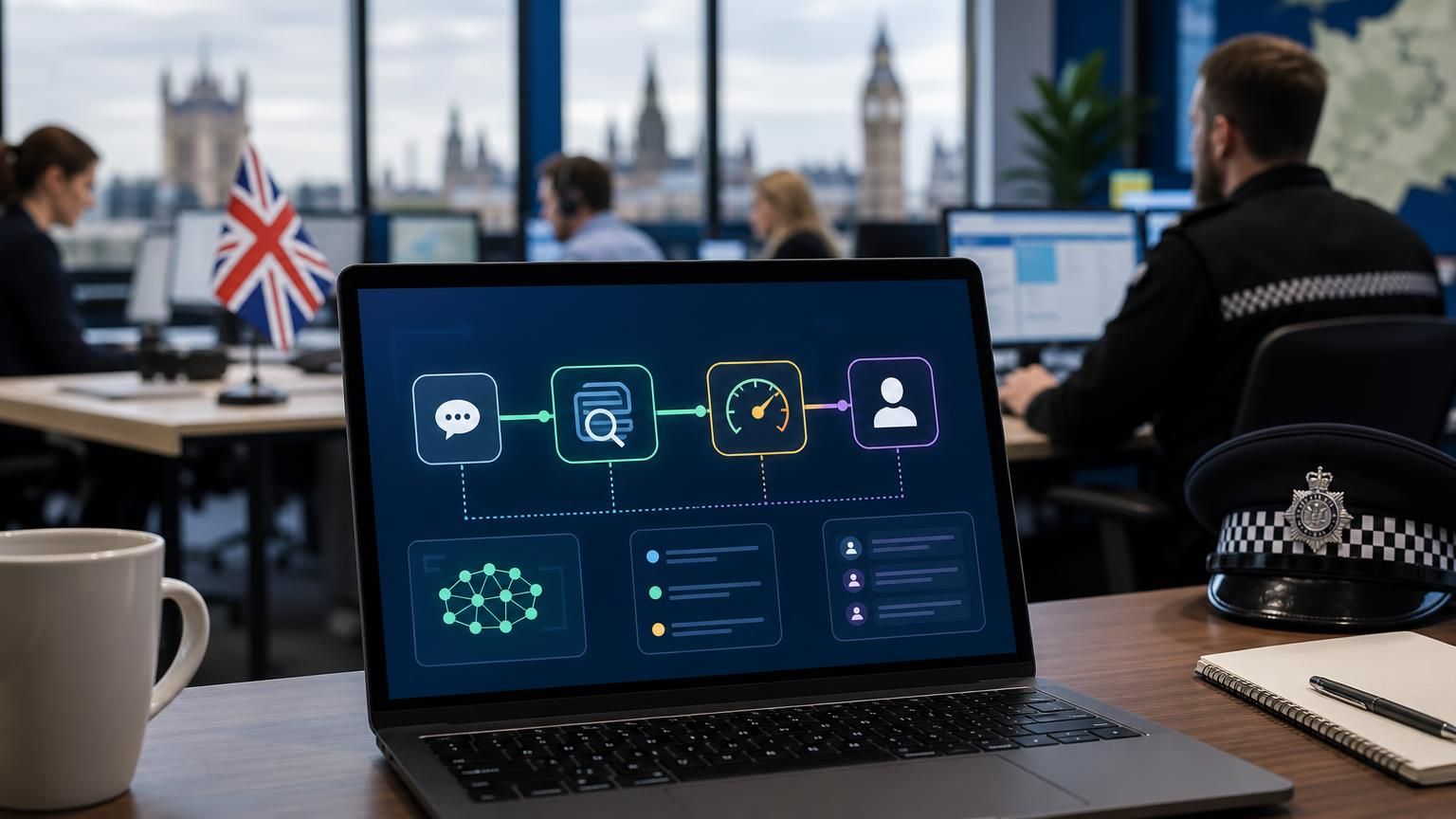
- Hybrid AI live chat: AI handles instant triage, suggested answers and low-risk requests, while the platform keeps deterministic handoffs, confidence metadata, auditable RAG retrieval, and immediate escalation to humans when needed.
For surge resilience, hybrid AI wins: it preserves speed while enabling auditable human oversight and controlled escalation policies that meet regulatory needs.
A simple resilience architecture that actually works for UK regulated teams
Design principle: keep sovereignty, auditability and escalation baked into the chat stack.
Core components:
- UK‑hosted RAG knowledge layer for fast, verifiable answers and to stop data leaving trusted territory. Link retrievals to discrete evidence snippets so every AI suggestion has a traceable source. (This is the technical backbone for safe automation.)
- Confidence signals and threshold policy: if confidence < X% or query classified as ‘regulated’ or ‘safety’, hand off immediately to a named human queue.
- Escalation workflows that preserve SLA rules and generate service tickets with timestamps, user consent metadata, and a minimised evidence pack for later audits.
- Surge mode: dynamic routing that temporarily expands permitted AI handling scope for pre-approved low‑risk categories while opening more agent seats via temporary contractors or remote duty teams.
These patterns let you increase automated throughput without sacrificing regulatory controls.
Practical gains businesses and councils can expect
- Faster first response for high-volume enquiries — customers expect online channels; businesses that use chat well commonly see measurable gains in engagement and conversion. Live chat can lift conversions and reduce time‑to‑answer when integrated into sales and support flows. ()
- Fewer SLA breaches during surges: automate repeatable, low‑risk tasks and use RAG‑backed answers so humans focus only on exceptions.
- Evidence and auditability: every AI suggestion is stored with provenance and confidence metadata so regulated teams can reconstruct decision chains during reviews.
How to set escalation and SLA policies that regulators will accept
Keep it simple and defensible: policy should be a combination of intent classification, confidence scoring, and user consent.
- Pre‑classify enquiry types by risk (e.g. safeguarding, FOI, legal advice, benefits claims). High‑risk categories are always human‑handled.
- Use confidence thresholds derived from live testing; require human signoff for any automated action with legal impact.
- Log everything: timestamps, evidence snippets, agent IDs, and whether an AI suggestion was followed or overridden.
This approach aligns with emerging UK public‑sector expectations for AI impact evaluation and data ethics by building measurable controls into the operational design. (gov.uk)
Operational playbook for a strike, cyber incident or sudden demand spike
- Predefine surge categories and escalation matrices in the chat workflow engine.
- Ensure the RAG knowledge layer is current and hosted within the UK to meet data sovereignty requirements.
- Switch to a ‘surge‑assisted’ routing profile: let hybrid AI triage and resolve low‑risk queries, open human queues for exceptions.
- Record and export auditable incident packs for any statutory reporting.
Test this in low-risk windows and rehearse the playbook quarterly — you want the cutover to be a toggle, not a rebuild.
Security, data protection and procurement — the non‑negotiables
- UK hosting: keep all RAG index data and logs on UK infrastructure to simplify information‑sharing agreements and FOI/DPA responses.
- Cyber Code alignment: document your LLM API configurations, secrets management and access controls as part of procurement and accreditation. The AI Cyber Security Code provides implementation guidance on securing AI pipelines. (assets.publishing.service.gov.uk)
- ICO expectations: ensure anonymisation, purpose limitation, and fair processing notices are in place when chat data is used for model tuning or analytics. (ico.org.uk)
Procurement teams should require: UK data residency assurances, RAG evidence export, configurable confidence thresholds, and an immutable audit trail for every conversation.
Quick tech checklist (for solution architects and procurement leads)
- Is your RAG index UK‑hosted and updatable without vendor‑side model retraining? Link fast retrieval to agent evidence. (See feature details.) https://imsupporting.com/feature-rag-based-ai-agent-knowledge.php
- Does your platform let you author surge workflows, set confidence thresholds and auto‑escalate? https://imsupporting.com/feature-hybrid-ai-chat-workflows.php
- Can you export a certified incident pack containing conversation transcripts, evidence snippets and escalation metadata within 24 hours?
Realities and tradeoffs — what boards must accept
- Hybrid AI is not a silver bullet: it reduces load but requires investment in governance, test data, and periodic review.
- There’s a small operational cost to keep RAG indices current — but that cost is far lower than SLA penalties, regulatory complaints, or reputational damage.
Next steps and a recommended pilot
Run a 90‑day surge resilience pilot focused on a single high‑volume, low‑risk service (e.g. bin collections, council tax queries, non‑urgent police admin). Measure:
- First response time
- % of enquiries resolved without human touch
- Number of SLA breaches
- Audit pack completeness and time to export
If the pilot meets recovery SLAs and audit standards, scale across additional services.
Final word — make resilience decision‑grade, not experimental
Public and regulated services need live chat that’s fast and auditable. Hybrid AI, when built on a UK‑hosted RAG backbone with clear escalation policies, preserves SLAs during strikes, cyber incidents and demand spikes — and it does so in a way procurement teams can specify and auditors can verify. For UK councils, police forces, housing associations and regulated organisations, that’s the difference between a reputational hit and continued service delivery.
Explore a platform built around these principles and test a resilience pilot with a UK‑hosted hybrid AI solution today: https://imsupporting.com/.
Call to action: Book a demo and ask for a surge‑resilience pilot and RAG evidence export trial at https://imsupporting.com/ — ensure your service can scale without compromising auditability or data sovereignty.