
The idea — three lanes, one compliant support road
Cut the theory: split your live chat into three operational lanes so UK organisations get predictable outcomes, auditable trails and data sovereignty baked in.
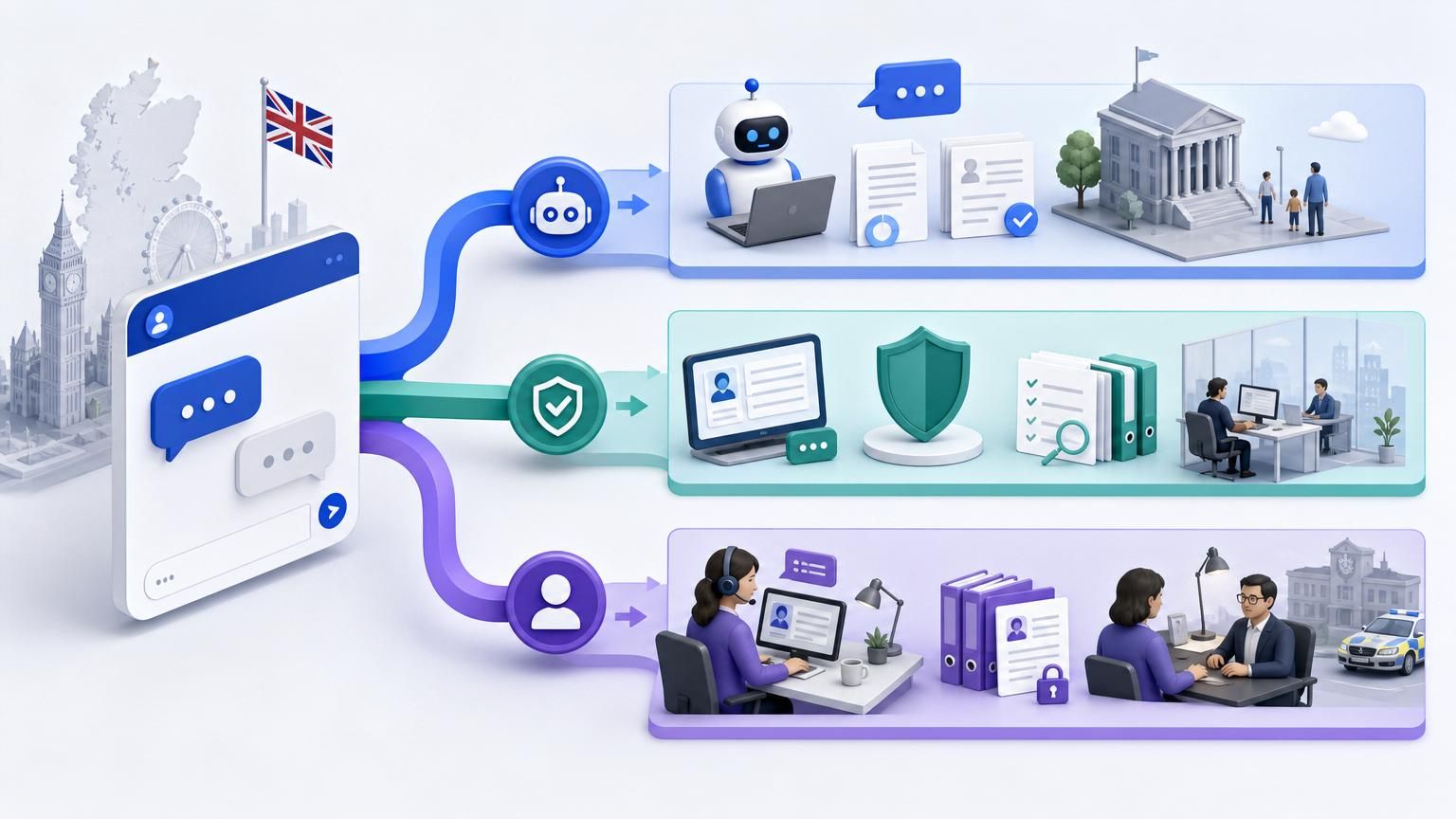
The Three‑Lane model separates support into:
- Lane 1 — Instant Self‑Serve AI: fast, RAG‑grounded answers for routine queries (no PII stored outside UK control).
- Lane 2 — Supervised AI + Policy Gate: AI triage using local knowledge stores and policy checks that can redact or route anything flagged for human review.
- Lane 3 — Human‑Only Case Handling: high‑risk, regulated or sensitive contacts handled by trained agents with full audit logging.
This structure turns live chat from a single sprint lane into a practical rules-and-evidence chassis that UK councils, police non-emergency teams, housing associations and regulated businesses can actually buy, operate and defend.
Why this works for UK teams now
- It enforces data‑sovereignty as a first principle: keep the knowledge base and vector store in UK‑hosted infrastructure, and avoid cross‑border exposure during initial triage. See how RAG can be used to ground answers in your own documents. (imsupporting.com)
- It separates risk: routine queries are resolved quickly; only policy or PII issues escalate to humans — reducing backlog and exposure.
- It aligns with the UK regulatory backdrop: the Government’s pro‑innovation approach to AI demands sensible governance and proportionate controls. Use a risk-based approach when you design lanes and handoffs. (gov.uk)
- ICO guidance makes it clear: processing using AI still requires data‑protection by design, DPIAs where appropriate and human review where decisions are significant — exactly what Lane 2 and Lane 3 deliver. (ico.org.uk)
A practical stat: AI adoption is still nascent in UK firms (9% in 2023), so a staged, lane-based rollout reduces political and operational friction inside councils and regulated teams. (ons.gov.uk)
Avoid the trap: rule-based bots vs pure LLM bots vs hybrid AI
- Rule‑based chatbots
- Defined scripts and exact intent trees.
- Low risk and predictable, but brittle: they fail quickly if the user uses unexpected phrasing.
- Pure LLM bots
- Large language models that generate free text without grounding.
- Fast, fluent and risky — hallucinations and uncontrolled access to sensitive data are real problems for public sector procurement.
- Hybrid AI live chat
- RAG‑augmented LLMs (or smaller models) that retrieve answers from your verified documents, plus policy gates and human handoff workflows.
- Best of both worlds: accuracy and speed with auditable context. IMSupporting’s RAG and hybrid workflow features are built to operate this way. (imsupporting.com)
Use the Three‑Lane model to combine these approaches safely: keep rule‑based logic for form capture and routing, RAG for grounded answers in Lane 1, and human casework for complex matters.
How to design each lane (practical checklist)
Lane 1 — Instant Self‑Serve AI
- Host your vector store and KB in a UK data centre.
- Use RAG so answers cite the exact document fragment and include a “source” token to record provenance. (imsupporting.com)
- Limit actions (no payments, no PII updates) — this prevents accidental exposure.
- Measure: deflection rate, average time to answer, citation accuracy.
Lane 2 — Supervised AI + Policy Gate
- Deploy a policy engine that scans AI responses for trigger phrases (PII, legal, safeguarding, financial terms).
- If a trigger appears, either redact sensitive bits and continue, or insert an automatic escalation to Lane 3.
- Use human‑in‑the‑loop review queues and “agent suggested response” mode.
- Measure: false positives, handoff latency, human override rate.
Lane 3 — Human‑Only Case Handling
- Full audit logging, case number creation, and retention policies aligned to ICO guidance and organisational records schedules. (ico.org.uk)
- Trained operators with scripts for safeguarding, evidentiary handling and local authority processes.
- Measure: first‑time fix, SLA compliance, and audit completeness.
Implementation blueprint (30–90 day roadmap)
- Week 0–2: policy mapping workshop — define what must never be automated (safeguarding, FOI, legal decisions).
- Week 3–5: build UK-hosted RAG KB and simple Lane 1 workflows; test with low‑risk pages.
- Week 6–8: add policy gates and supervised AI behaviors; begin hybrid hours where humans shadow AI.
- Week 9–12: go live with phased coverage; monitor KPIs and adjust rules. Use analytics to find misroutes and tune triggers.
IMSupporting provides a visual workflow builder that maps cleanly to this roadmap and supports conditional routing, API calls, and AI handoff modules. See the Hybrid AI Chat Workflows and AI Agent Handoff modules for concrete tools to build each lane. (imsupporting.com)
Measurements that matter for procurement and execs
- Deflection vs. escalation ratio (how many chats finish in Lane 1 vs escalate).
- Time to resolution across lanes and SLA attainment for regulated requests.
- Audit trail completeness: percent of handoffs with linked evidence and redaction metadata.
- Citizen satisfaction for councils and police non‑emergency contact where trust matters.
Those metrics win procurement conversations: they show both efficiency and governance — not just cost cutting.
Public sector and regulated use cases (practical examples)
- Council tax queries: Lane 1 answers rates/holidays via RAG; Lane 2 flags PII updates for redaction; Lane 3 processes council tax exemptions.
- Police 101 digital contact: use Lane 1 for non‑urgent guidance; Lane 2 flags safeguarding words and triggers immediate human review; Lane 3 records evidence and referral steps.
- Housing associations: Lane 1 handles repair guidance; Lane 2 identifies tenancy disputes and routes to human caseworkers.
Each use case benefits from UK hosting, a clear redaction policy, and built‑in audit trails — all controls the ICO expects you to document. (ico.org.uk)
Risk register (quick wins to reduce exposure)
- Keep training data local and remove PII from public training corpora.
- Require explicit consent flows before collecting personal details in any lane.
- Implement rate limits and anomaly detection to avoid automated scraping or exfiltration.
These are pragmatic, not theoretical — and they map to the ICO’s recommendations on security, minimisation and governance. (ico.org.uk)
Where to start: tooling and next steps
If you want a turnkey way to build the Three‑Lane model, pick a UK‑hosted platform that supports RAG knowledge, conditional workflow routing and auditable AI→human handoffs. IMSupporting publishes ready modules for RAG knowledge and Hybrid AI Chat Workflows that match this design and help you move from pilot to production. (imsupporting.com)
Strong CTA — see it in action: try a demo or start a free plan at IMSupporting and test a Lane 1 pilot on a low‑risk page today: https://imsupporting.com/.
Start with a single high‑traffic page, prove deflection, lock down your policy gates, then expand — that sequence reduces risk and builds trust with public sector buyers and regulated decision‑makers.