The idea in one line
Build a UK‑hosted RAG (retrieval‑augmented generation) “edge” that keeps sensitive documents and vectors inside British data centres, uses LLMs only as a controlled reasoning layer, and routes everything through a hybrid AI live chat workflow that guarantees auditable human handovers for councils, police and regulated services.

Why this angle matters now
- UK public bodies and regulated organisations are buying AI but procurement and compliance rules demand clear onshore controls. GOV.UK procurement guidance and the AI playbook ask buyers to treat procurement as a governance lever — not a blind sprint. (gov.uk)
- The ICO’s recent internal AI guidance mandates human review, audit trails and risk-aware deployment for chatbots and generative AI used on personal data. That makes architectural constraints — where data sits and how models access it — a procurement must‑have. (ico.org.uk)
- Practically, slow or uncontrolled chat increases abandonment and damages outcomes: Forrester research and industry benchmarks show a steep abandonment curve once first response times slip past a couple of minutes. Organisations must combine instant triage with reliable escalation. ()
This article gives a distinct, commercially focused blueprint — the RAG Edge — for decision-makers who must balance performance, conversion and auditability while keeping everything UK‑hosted.
Rule‑based chatbots, pure LLM bots and hybrid AI — quick differentiation
- Rule‑based chatbots: deterministic scripts, menu trees, and simple pattern matches. Low risk, low intelligence. Best for simple FAQs but brittle for casework.
- Pure LLM bots: generative models that answer from learned parameters. Fast and flexible but prone to hallucination and problematic when used on sensitive case records.
- Hybrid AI live chat: a RAG-backed retrieval layer serves verified, on‑site documents to an LLM or decision engine; AI performs triage and drafting, and the system enforces auditable handovers to human agents for sensitive or complex cases.
Hybrid AI is the practical middle ground for UK public services: it gives speed and scale while preserving proof, redaction and human judgement where it matters.
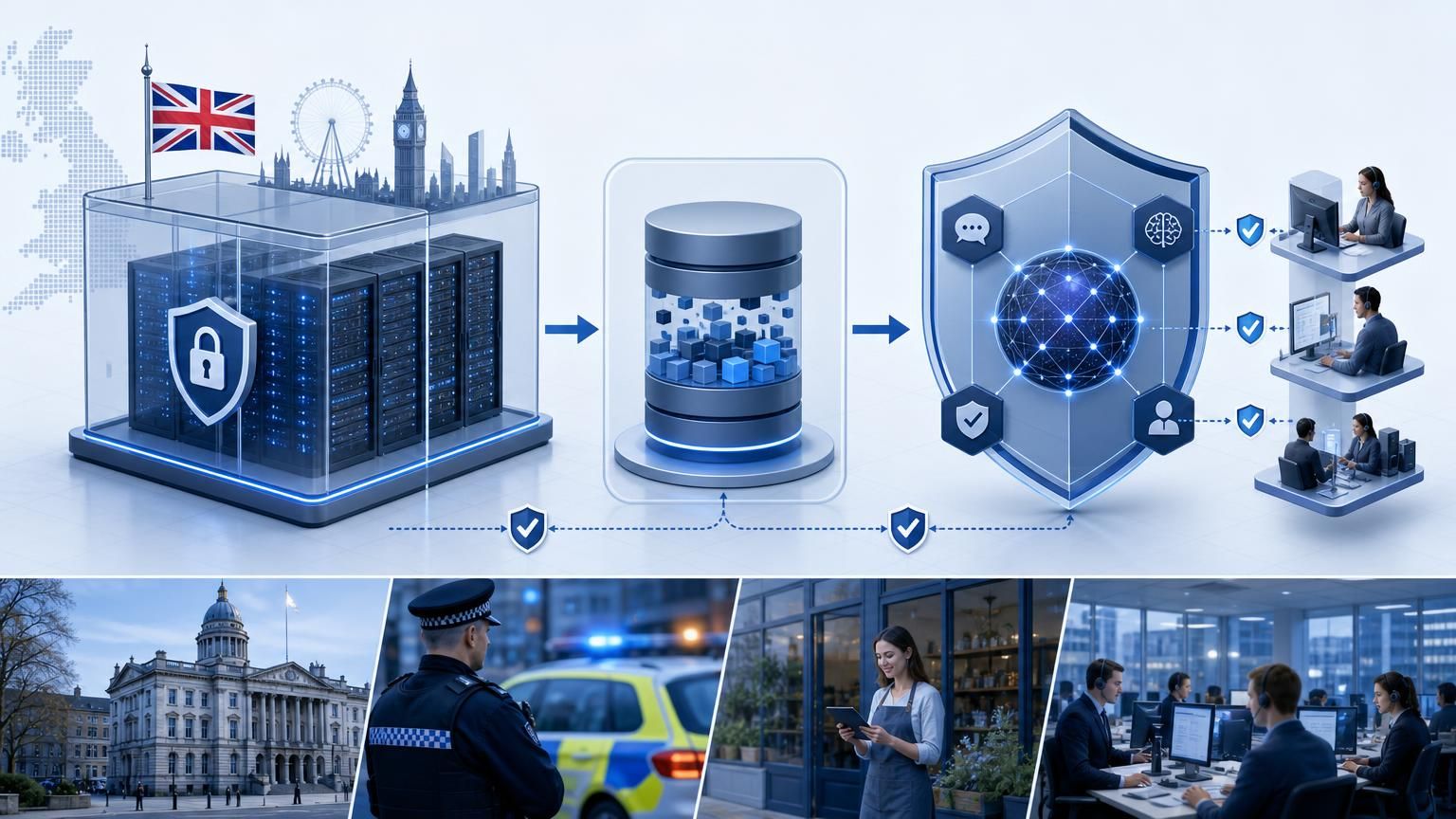
What a UK‑hosted RAG Edge architecture looks like
- Onshore document store: secure UK data centres hold case files, policies, and vector indexes — everything that must not leave UK jurisdiction.
- Retrieval service at the edge: a local vector retriever queries the onshore corpus and returns citations, snippets and metadata to the generator.
- Controlled LLM layer: the LLM (hosted either in a private cloud or accessed via a vetted vendor) receives only the retrieved context — never raw private stores — with explicit provenance tokens to limit hallucination. RAG models materially reduce factual drift by anchoring answers to documents. ()
- Policy & redaction middleware: inline PII scrubbing, role‑based data masks, and a rules engine that forces escalation on high‑risk trigger patterns (safeguarding flags, legal requests, homelessness claims, criminal case references).
- Audit & evidence log: immutable records of retrievals, AI outputs, redaction steps and agent edits stored for FOI, complaints and forensic review.
Concrete hybrid live chat workflow (operational pattern)
1. Instant triage at the edge
Visitor opens chat → RAG retrieval pulls relevant local docs → AI proposes a short answer and a risk score.
2. Smart handover rules
If risk score > threshold or case involves a restricted category, auto‑escalate to Duty Agent; otherwise present AI answer with a visible provenance card and an option to request human review.
3. Agent augmentation, not replacement
Human agents see the AI draft, the exact retrieved sources, and a ‘what changed’ diff before sending — improving speed while keeping human accountability.
4. Continuous learning loop
Agents flag inaccurate retrievals or policy misses; the system writes retriever feedback and adjusted relevance signals back to the RAG index during scheduled retraining windows.
This pattern reduces avoidable escalations, shaves average handling time and keeps sensitive material onshore where procurement and audit teams can inspect it.
Operational controls you must insist on
- UK data residency for primary indexes and logs to satisfy procurement and data sovereignty rules. (Make it explicit in contracts.) (gov.uk)
- Auditable handover records and human review policies aligned to ICO guidance. (ico.org.uk)
- Retrievability and provenance for every AI reply — store the id of each document used in a response and the exact snippet returned. RAG methods are specifically designed for this. ()
- Policy enforcement at runtime: real‑time redaction and an approval gate for categories that require legal sign‑off.
Performance and ROI (what you can measure)
- Conversion and satisfaction: well‑designed live chat with proactive RAG replies can lift conversions on high‑intent pages; industry benchmarks show double‑digit improvements for proactive chats and higher AOV from engaged users. ()
- Reduced escalations: shift‑left outcomes by automating validated tier‑0 answers while ensuring tier‑1 agents only handle complex, high‑value interactions.
- Compliance overhead down: fewer manual redactions after implementing structured RAG retrieval and middleware policies.
One practical metric to watch: first response that includes an RAG provenance card (AI + citations) vs human‑only first response — you should see faster response times with comparable or improved CSAT when handovers are enforced correctly. ()
Implementation checklist for procurement and architecture teams
- Specify UK hosting for indexes and audit logs in the SOW.
- Require demonstrable RAG provenance and immutable audit logs during the pilot.
- Demand hybrid workflow controls: configurable risk thresholds, forced handovers, and agent review screens.
- Insist on an explainable retraining pathway (agent feedback → index updates) and on‑premise option for particularly sensitive datasets.
For a ready blueprint and feature examples, see IMSupporting’s RAG agent knowledge and hybrid AI workflow pages: https://imsupporting.com/feature-rag-based-ai-agent-knowledge.php and https://imsupporting.com/feature-hybrid-ai-chat-workflows.php. You can also review the supplier’s main platform capabilities here: https://imsupporting.com/.
Final recommendation — a pragmatic first step
Run a two‑month pilot that: keeps the vector index in a UK data centre; connects a controlled LLM via RAG; enforces redaction and handover rules; measures abandonment, FRT and escalation rate. Use the pilot to tune thresholds and to create the human review SOPs your audit and legal teams will want to see.
If you need a procurement‑friendly platform that already supports UK‑hosted RAG and configurable hybrid workflows, review IMSupporting’s platform and ask for an onshore pilot. Stronger controls today reduce risk and improve outcomes tomorrow. https://imsupporting.com/.
Quick reading list (policy & tech)
- GOV.UK Guidelines for AI procurement and the AI playbook. (gov.uk)
- ICO internal AI guidance and policy expectations for human review and audit. (ico.org.uk)
- RAG research and surveys on retrieval‑anchored LLMs. ()
Call to action: if you’re leading support or procurement for a council, housing association, police or regulated service and you need a UK‑hosted RAG live chat pilot with auditable human handovers, start a conversation with the IMSupporting team at https://imsupporting.com/.