Why this matters now

UK public services and regulated organisations can no longer treat live chat as a bolt-on; it must be an auditable, UK-hosted channel that scales human expertise with AI-led triage. Webchat is already a mainstream contact route — for mobile customers it was the second most popular channel in 2024, accounting for a material share of interactions. ()
This post gives a compact, procurement‑ready playbook for support leaders, solution architects and SaaS marketers: how to choose and operate hybrid AI live chat that balances accuracy, auditability and UK data sovereignty.
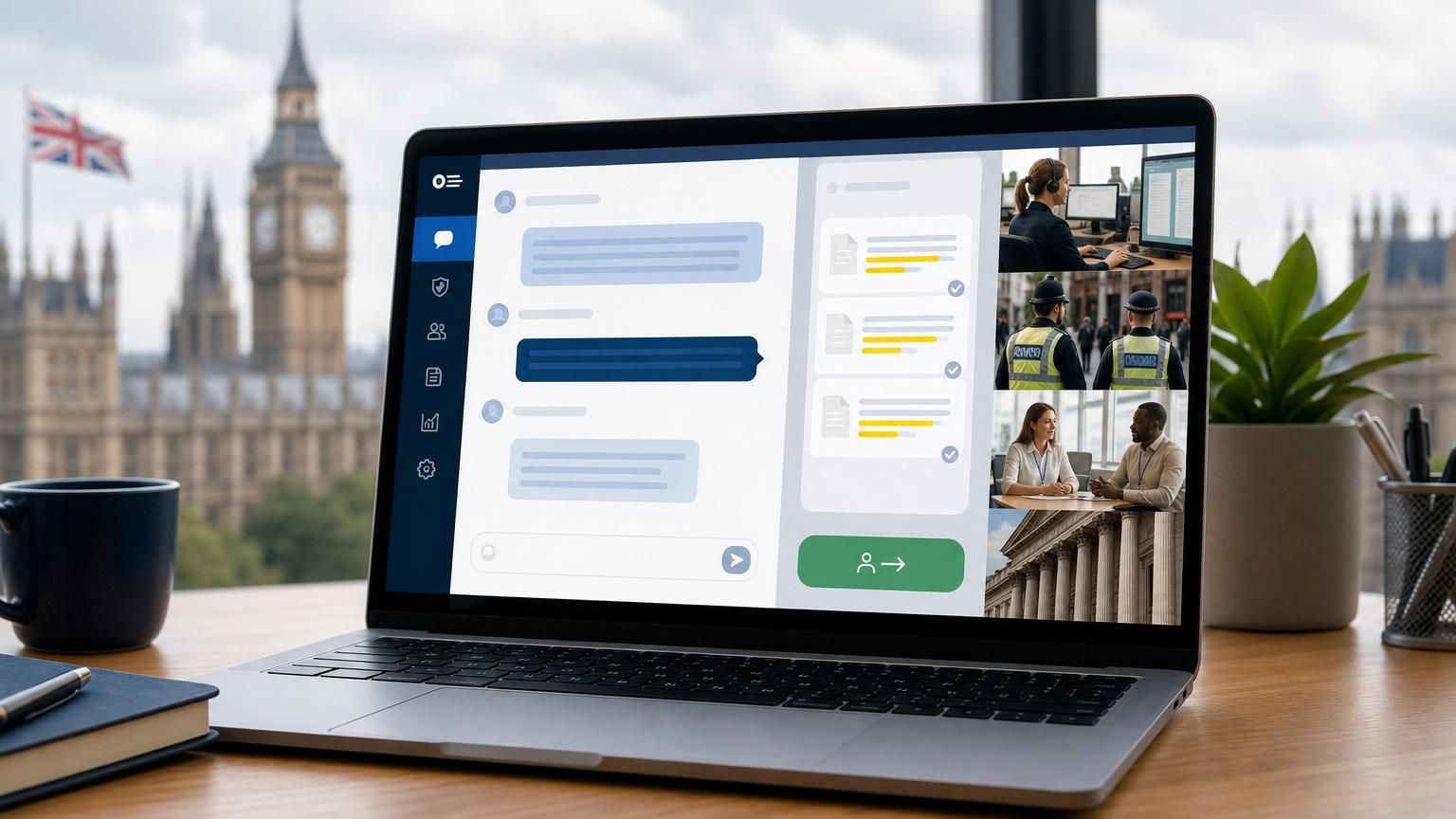
Three technology layers every buyer must separate
If you evaluate vendors without fixing these layers you will be sold feature noise, not architectural guarantees.
- Rule‑based chatbots: scripted flows, menu-driven responses and deterministic routing. Good for forms, simple FAQs and policy-compliant procedures. Low risk but brittle at scale.
- Pure LLM bots: generative models that answer from their internal weights. Fast, flexible and conversational — but prone to hallucination, unpredictable phrasing and difficult-to-audit decision trails.
- Hybrid AI live chat (what you should prefer): a RAG-enabled retrieval layer plus guided LLM outputs, plus explicit hand-off to human agents and workflow automation. Hybrid AI keeps generation grounded and provides a deterministic audit trail.
Separate these in procurement language: ask vendors to disclose which layer powers each scenario, and require explicit handover points from AI to humans.
Why RAG and agent workflows are the backbone (not a gimmick)
RAG — Retrieval‑Augmented Generation — is the practical way to keep generative answers tied to your documents, policies and case records. Modern enterprise RAG patterns have moved past simple prototypes into production pipelines with hybrid search, reranking and policy-aware retrieval. ()
But RAG alone isn’t enough. Production-grade systems must:
- enforce access controls at retrieval time (don’t dump confidential docs into a central vector store without permissions),
- surface provenance markers so agents can see which document fragment the AI used,
- and embed policy signals that trigger human escalation for high‑risk queries.
If you want a vendor demo checklist that proves RAG maturity, look for: configurable retrievers, query transformation (to map user language into document queries), provenance display in the agent UI, and audit logs that record retrieved document IDs.
UK-hosting and regulation: checklist for councils, police and regulated teams
Regulated teams must be able to demonstrate where data is stored, who can access it, and an auditable trail for FOI or ICO review. The ICO’s guidance and resources on AI expect organisations to follow principled approaches to documentation, DPIAs and explainability. Ensure you can evidence those controls. (ico.org.uk)
Procurement checklist (core asks):
- UK‑hosted tenancy and data residency guarantee (not just an option).
- Export controls on vectors and logs — confirm no automatic cross-border replication.
- Role-based access logs and immutable transcripts tied to case IDs.
- DPIA and model‑risk assessments available as part of the contract.
Operational design patterns that work in UK support teams
1) Triage + escalate (best for councils and police front desks)
- AI performs first-pass triage: collects contextual fields, matches policy tags, and suggests a knowledge fragment.
- If a policy tag is high‑risk (safeguarding, crime report, tenancy eviction), the workflow forces immediate human takeover and creates an evidence bundle.
2) Guided agent assist (best for regulated teams)
- AI suggests exact script lines, citations and next-step checklists in the agent UI.
- Agents choose, edit and record the final text — so the human remains the accountable author.
3) Automated closure for low-risk queries
- For transactional, low-risk requests (billing dates, opening hours), AI can complete the interaction including case closure — but only with a short, stamped transcript and optional human review.
Procurement language you can copy (three short clauses)
- "Data residency: All production customer data, vector indices, logs and backups will be hosted in UK-based data centres and will not be replicated outside the UK without written consent."
- "Explainability: For every AI-generated reply the vendor will provide the identifier of the retrieved source document(s), retrieval score(s) and version of the model used."
- "Escalation: Vendor will support configurable policy tags that force synchronous human handover and automatically open a case record in the customer’s case management system."
These clauses make RfPs commercially rigorous and avoid vague 'AI-enabled' marketing claims.
Measuring impact: short, measurable KPIs
- Time-to-first-response reduced (target: 30–60 seconds for webchat triage).
- Human handle-time reduction on routine cases (target: 20–40% decrease within 90 days).
- Reduction in repeat contact rate for common queries (target: 15–25% after RAG knowledge tuning).
Practical evidence matters: ask for a 90‑day pilot with baseline KPIs and signed SLA for data residency and support.
Vendor features to demand (beyond marketing speak)
- RAG with provenance and document IDs visible to agents. See an example feature set here: https://imsupporting.com/feature-rag-based-ai-agent-knowledge.php
- Hybrid chat workflows that let AI triage, author drafts and hand off to agents with audit bundles. See hybrid workflow design here: https://imsupporting.com/feature-hybrid-ai-chat-workflows.php
- A UK-hosted service option and explicit audit/log export for FOI and internal audits. Link vendor homepage for procurement review: https://imsupporting.com/
Short procurement red flags
- Vendor refuses to guarantee UK hosting or uses generic 'EU or UK' language without contract clauses.
- The demo hides retrieval provenance or cannot show where the AI pulled an answer from.
- No DPIA or model risk summary available for review.
Final practical steps for busy leaders
- Run a 90‑day pilot on a single high-volume use case (billing, booking, or simple report intake).
- Insist on UK hosting and retrieval provenance during the demo and in the SCS schedule. (ico.org.uk)
- Measure handle time, repeat contacts and FOI readiness. If the vendor can’t export auditable bundles, walk away.
Hybrid AI live chat is now a core operational choice — not a fancy add-on. When it’s architected as RAG + guided LLM + human workflows and deployed with UK hosting and clear audit trails, it reduces caseload, speeds responses and keeps regulated teams compliant. The rules you set in procurement determine whether you get a strategic channel or a risky experiment.
Ready to evaluate platforms that were built with UK-hosting and hybrid workflows in mind? Start with a vendor that documents RAG provenance, workflow handoffs and UK tenancy guarantees — see how IMSupporting frames these capabilities and request a pilot at https://imsupporting.com/.